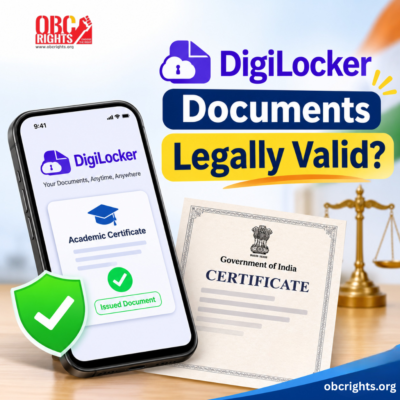
Are DigiLocker documents legally valid in India? Yes. Documents issued through DigiLocker by authorised organisations are legally recognised at par with their physical originals under Rule 9A of the Digital Locker Rules.
This applies across India, including Tamil Nadu. However, a document must be officially issued through DigiLocker, and colleges, employers or government offices may have additional verification requirements.
What Is the Legal Validity of DigiLocker Documents?
The DigiLocker documents legal validity comes from Rule 9A of the Information Technology (Preservation and Retention of Information by Intermediaries Providing Digital Locker Facilities) Rules, 2016, introduced through a 2017 amendment.
The rule recognises digitally signed documents issued and shared through the DigiLocker system at par with their physical counterparts.
This means you can use eligible digital documents without having to produce a paper original solely to establish the document’s authenticity.
Official reference: DigiLocker Rules and Amendments
Which DigiLocker Documents Are Legally Valid?
The important difference is where the document came from.
| Document type | Legal recognition |
| Issued Documents | Records provided by authorised issuers are recognised under Rule 9A. |
| Uploaded Documents | Scanned files stored in DigiLocker Drive do not automatically receive the same issuer-verified status. |
| Screenshots | A screenshot alone is not equivalent to sharing a verifiable issued document. |
For example, a marksheet retrieved directly from an education board through DigiLocker is different from a photograph of the marksheet uploaded by a student.
If you’re new to the platform, the distinction is easier to understand when you know what DigiLocker is and how it works and helps students
Where Are DigiLocker Documents Accepted?
Several government bodies have issued instructions recognising specified DigiLocker documents.
1. Colleges and universities
The University Grants Commission (UGC) has asked higher education institutions to accept degrees, marksheets and other academic records available through DigiLocker and the National Academic Depository (NAD).
2. Government jobs
DigiLocker-issued documents have legal recognition, but candidates must still follow the recruitment notification. Some processes may require a particular certificate format, issue date or verification procedure.
3. Driving and vehicle documents
The Ministry of Road Transport and Highways recognises eligible driving licences and registration certificates presented through DigiLocker or mParivahan.
4. Other government and financial services
DigiLocker supports document verification across participating public services and financial institutions. Acceptance depends on the document and the service’s requirements.
See the official DigiLocker government circulars for acceptance instructions.
Are DigiLocker Documents Valid in Every Indian State?
Yes, the central legal framework applies throughout India. DigiLocker documents do not become legally invalid simply because you move from one state to another.
However, individual departments may follow different procedures for receiving or checking records.
For example, a digitally issued marksheet may be legally recognised, while a college may separately require a school-leaving certificate or another document during admission.
The right question is whether your specific DigiLocker document meets the requirements of that particular service.
Can a College or Government Office Refuse DigiLocker Documents?
A legally valid DigiLocker record should not be dismissed merely because it is digital. However, an authority may identify a separate problem, such as missing mandatory documents or failure to complete verification on time.
In Hritika Mitra v. Registrar, Ravenshaw University (25 June 2021), the Orissa High Court dismissed an admission-related petition involving digital academic documents. The case also concerned missed counselling requirements and other mandatory original documents.
Key takeaway: DigiLocker validity does not remove the need to meet admission deadlines or submit other required records.
What Should You Do If a DigiLocker Document Is Refused?
If an institution refuses your document, follow these steps:
- Check the document: Make sure it appears under Issued Documents, not merely DigiLocker Drive.
- Show the official record: Open DigiLocker and offer the available document-sharing or verification option.
- Check the requirement: Ask whether the institution needs a different document, prescribed format or additional verification.
- Request clarification: If a valid issued document is rejected solely because it is digital, refer to Rule 9A and the relevant government circular. Request a written reason and use the official grievance process if needed.
Recent Government Update: DigiLocker in 2026
On 12 August 2026, the Ministry of Electronics and Information Technology reported that DigiLocker offered 5,437 document types and services as of 31 July 2026, covering Central and State Government services.
This shows the platform’s expanding use. It does not mean every document is accepted for every procedure.
Read the Government Update – PIB
Frequently Asked Questions
1. Is a Printed DigiLocker Document Valid?
An officially issued DigiLocker record has legal recognition in electronic form. If you print it, the receiving authority may need to verify its digital signature, QR code or original DigiLocker record.
2. Are DigiLocker Marksheets Equal to Original Certificates?
Yes. Marksheets officially issued through DigiLocker NAD are recognised at par with physical academic records. Follow the relevant admission or recruitment instructions for submission.
Need Help Understanding DigiLocker Document Validity?
If your DigiLocker certificate is not accepted, first check whether it is an official issued document and whether you have met the receiving authority’s requirements.
For additional guidance on digital documents and government services, visit OBC Rights People Point.
Official References
- DigiLocker Rules and Amendments
- National Academic Depository – Legal Validity
- UGC – Acceptance of DigiLocker Academic Documents
- DigiLocker – Government Circulars
- PIB – DigiLocker Government Update, August 2026
Updated: 4 November 2026. This guide explains general legal recognition. Specific document and verification requirements depend on the relevant authority.